


By Vihan Patel | Head of AI Solutions, Mantel
Executive summary
Key takeaways for the C-suite
- Nearly half of Australians integrated AI assistants into their 2025 holiday shopping
- “On-canvas” proprietary AI is fast becoming non-negotiable for brand loyalty and conversion
- Multi-expert AI agent interfaces show higher purchase confidence and perceived decision quality
- Retailers must invest in flexible, agent-friendly infrastructure today, not after competitors release their MVPs
For the modern retailer, the friction between product consideration and conversion is being engineered away. As we move further into 2026, the industry is witnessing a fundamental shift in consumer behaviour: nearly half of Australians integrated AI assistants into their 2025 holiday shopping. For ambitious brands, providing an autonomous, integrated, and trustworthy shopping experience is no longer a ‘nice-to-have’.
Many organisations are grappling with the tension between ‘on canvas’ – wholly proprietary and onsite AI – and ‘off canvas’, such as ChatGPT or Claude, AI experiences. The best answer we have now is to invest in both – and how heavily to invest in either channel will emerge somehow out of the messy middle between customer loyalty, technology investment, competitive dynamics and entrenched user behaviour.
The on-canvas experience is nonetheless fast becoming non-negotiable, and organisations that command customer loyalty and will continue to invest in a suite of proprietary ‘closed’ experiences will also need to work harder to differentiate their on-canvas experience from competitors.
So far, we’re seeing generation one of agentic commerce – the core infrastructure (e.g. product catalogues, payments infrastructure) connected to helpful chat-based assistants with an entry point via open-ended product discovery tooling like recipe generators or virtual try-on.
Here we present some ideas on what the next generation of these experiences might look like, and explain why preparing for the next evolution is critical today.
Are You More Likely to Purchase From an AI Expert? The Case for Multi-Agent Shopping
Many users depend on AI assistants to help make decisions in areas where they’re unfamiliar. The process of narrowing down to a single product is simultaneously a journey to better understand my decision criteria, and the products that fit these the best.
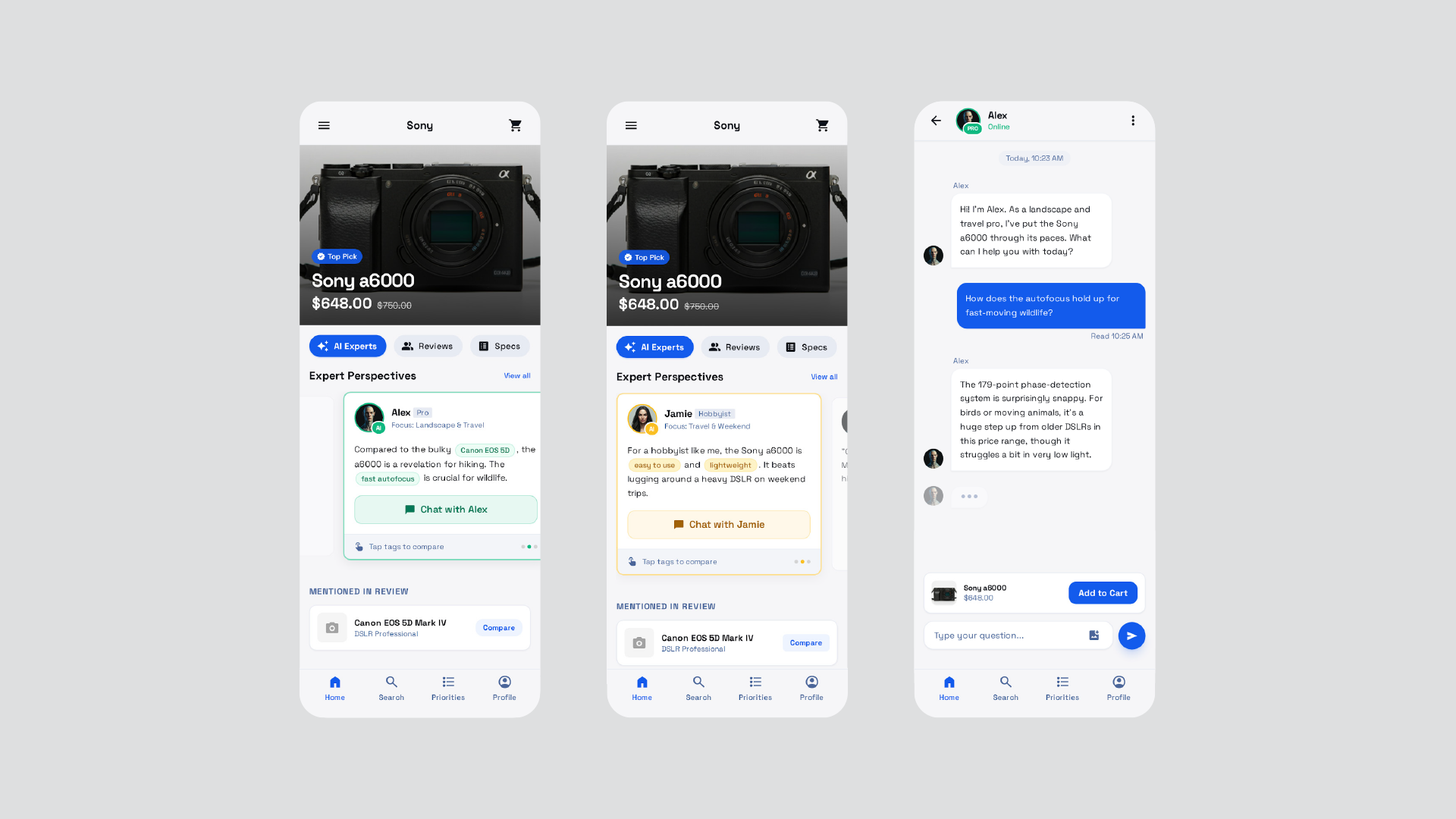
We noticed a recently published paper that explores this idea with a new agentic interface. By exposing shoppers to a suite of agents covering multiple expert perspectives, people were able to explore different viewpoints (even simultaneously), gradually form their decision criteria and in a more helpful way narrow down their choices.
In the small study users reported higher confidence in their final choice and better perceived decision quality – a promise that this in turn may help build longer-term trust in the AI tool.
In light of the research, our designers have mocked up what these interactions may look like. First, we have a set of experts with different perspectives on what makes for an ideal camera.
Next, we take this further – instead of a single interaction, what if these experts helped debate tradeoffs between two products? What if you could listen to this debate play out?
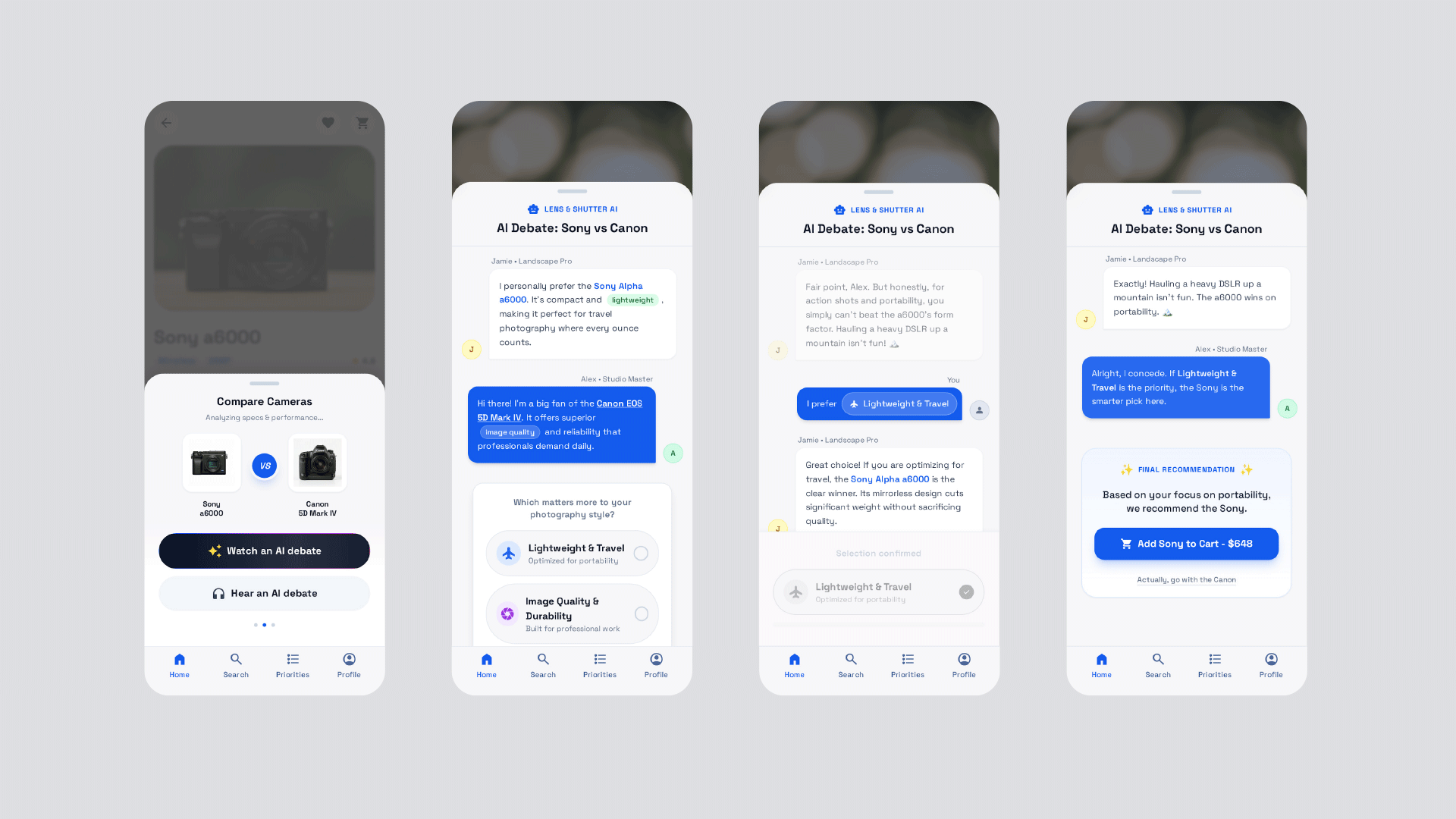
While this model may not be right for all organisations, we find it a compelling viewpoint particularly for those with challenging product discovery journeys and complex decision criteria – everything from technology retail as shown above, to insurance, vehicles, or even energy and utilities.
Personalisation in the Moment: Serving Both New and Loyal Customers
Authenticated agentic commerce experiences already start on the front-foot – your only grocery account is connected to your purchase history, and your ChatGPT account may already understand your lifestyle and health from previous conversations.
Unauthenticated experiences will require significant focus on in-the-moment personalisation in order to acquire new customers, build trust and convert.
Our AI experts above may be the first step on this journey – without having even selected a product, we might express interests by making an active choice on which persona we’d prefer to interact with. This immediately provides a reference on priorities, lifestyle, demographic, and potentially cross or upsell opportunities.
We also see this personalisation as playing out via the chat experience in real time. See the example below: two users with two very different goals implicit in their initial queries – across language, tone and content.
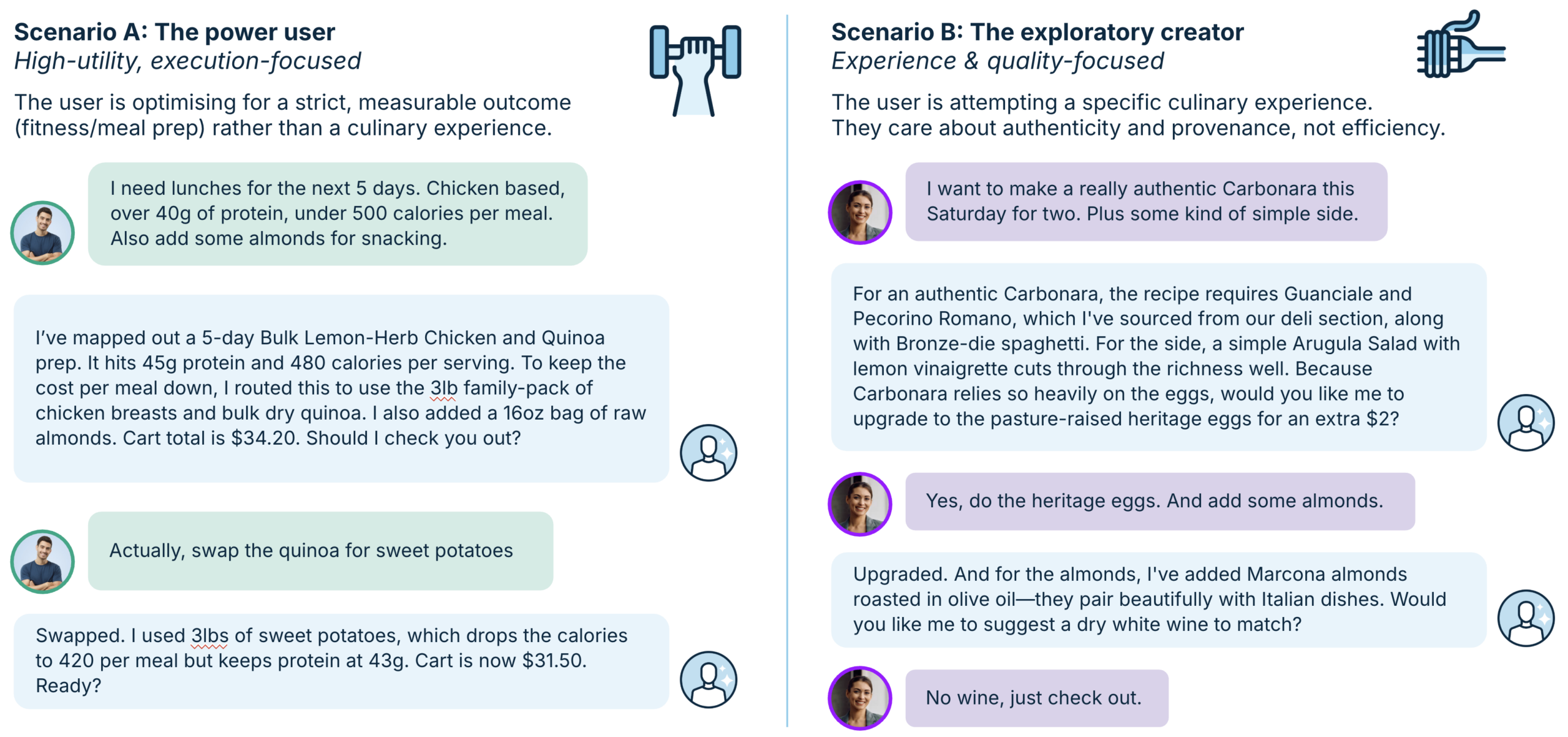
What’s critical is that an agentic assistant is able to adjust its persona, intent and tool usage to meet the user where they’re at in the moment. This may mean (within guardrails) rewriting or adjusting some of its system prompts, avoiding upselling or suggesting alternatives where customers display transaction-focused behaviour, or vice versa where they appear more open to exploration.
What this example helps us recognise is the importance of having a flexible underlying infrastructure, from the initial intent recognition, to API definitions and product search. Product search must also expand across both structured categories (e.g. calories, price) and unstructured qualities (e.g. authenticity). These are the data and infrastructure foundations of a flexible agentic experience that need to be developed today.
Building for the Next Generation: What Retailers Need to Do Now
Enabling these kinds of ideas requires building agent-friendly and extensible underlying infrastructure. See our previous piece on what makes for good “agent-experience” or AX.
Agentic commerce represents a generational shift in user behaviour, expectation and value accrual will follow those that meet user expectations – with genuinely helpful trusted digital assistants that understands them and their needs, in the moment.
Mantel’s recommendation is to plan for next gen agentic commerce even while building your first MVP, and to consider pushing the boundaries of this initial release in order to leapfrog your competitors, who are likely to release a sea of helpful but generic chatbots.
FAQ’s
What is the difference between a chatbot and an agentic commerce experience? A chatbot responds to queries with pre-defined or AI-generated answers. An agentic commerce experience uses AI agents that autonomously use tools (searching catalogues, comparing prices, checking stock, and completing purchases) with minimal user friction. The key difference is agency: agentic systems act, not just respond.
What does “on-canvas” vs “off-canvas” AI mean in retail? On-canvas AI refers to proprietary AI experiences embedded within a retailer’s own website or app. Off-canvas AI refers to third-party assistants like ChatGPT or Claude that shoppers use independently to research and make purchase decisions. Both channels require investment, but serve different roles in the customer journey.
How should retailers prepare for gen 2 agentic commerce? Retailers should invest in agent-friendly infrastructure today: structured and unstructured product search, flexible APIs, authenticated personalisation, and modular system prompt architectures that can adapt to different user intents. Building this foundation now prevents costly retrofitting later.
Are multi-expert AI agents better for conversion? Early research suggests yes – exposing shoppers to multiple expert AI perspectives (e.g. a performance-focused vs value-focused camera advisor) increases confidence in purchase decisions and perceived decision quality. This model is particularly effective for high-consideration purchases with complex decision criteria.
Which industries benefit most from agentic commerce? While agentic commerce applies broadly, it delivers the most value in categories with complex decision criteria or high purchase anxiety – technology retail, insurance, financial products, vehicles, energy, utilities, and health. Any category where a trusted human expert would historically have added value is a strong candidate.
