

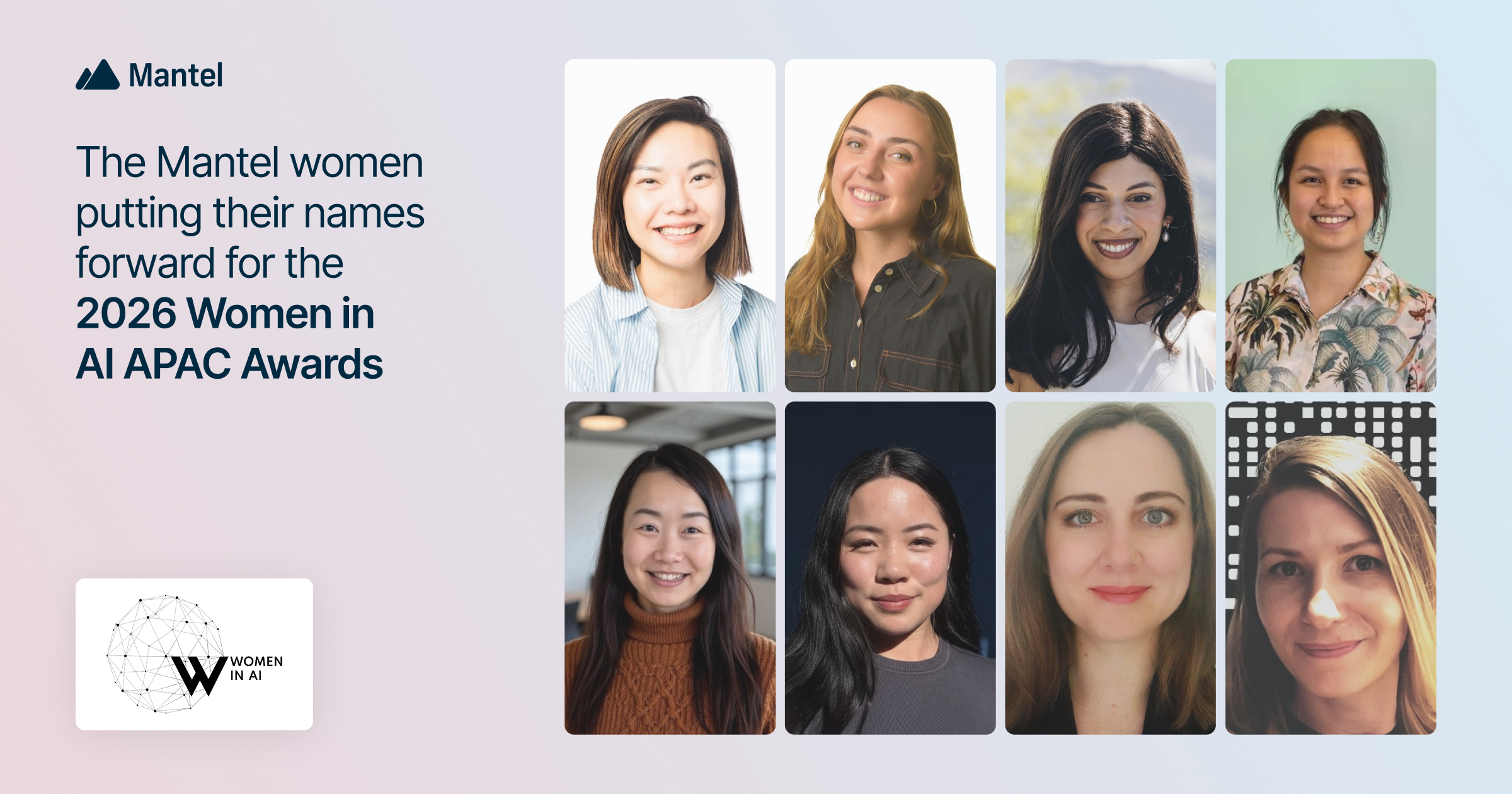
Every year, the Women in AI APAC Awards recognises the women shaping how artificial intelligence gets built and used across the region.
For 2026, a group of Mantellorians have entered, across categories spanning finance, infrastructure, governance, social good and agentic AI.
Reading their entries side by side, it’s evident that almost none of them arrived here in a straight line. Among them are a cardiac ICU nurse, a human rights advocate, a high school teacher, a poverty reduction specialist and a number of academic researchers. What they share is a conviction that the interesting question about AI is rarely “what is the technical solution,” but “how to we have an impact and Make Things Better.”
Read their stories below.
Vivian Mai, Lead Data Scientist
AI in Innovation
Vivian’s route into data and AI started during her PhD, when she taught herself to code to handle research data that Excel could not keep up with. Eight years on, she is the person enterprises call first for their most strategic and innovative work. Her entry centres on a real-time computer vision system that detects vehicles stopped dangerously on high-speed motorways, then alerts control room teams so incident response can move faster, and secondary collisions can be prevented.
The results are seriously impressive; detection accuracy above 90 percent against a previous benchmark closer to 50, with a sharp reduction in false alarms. She describes her approach as problem-first: find the actual problem, then reach for the right technology, rather than starting with the most impressive tool in the room.
Nicole Ramirez, Lead Machine Learning Engineer
AI in Finance and Tech
Nicole has spent six years in AI, moving from cancer research and data science into machine learning engineering and leadership. At Mantel, she has trained banks, enterprises and executives on machine learning fundamentals and helped upskill hundreds of consultants. Her entry focuses on her role as AI technical lead on a knowledge management and decision support platform for a major Australian investment institution.
In plain terms, it lets people ask a question in everyday language, search across hundreds of thousands of internal documents, and get answers they can trust and trace back to the source. She is now AI lead for the organisation’s AI Centre of Excellence. Democratising access to AI is her throughline. She believes the technology belongs to everyone, not just the specialists who build it, and she mentors early-career engineers to help widen who gets a seat at the table.
Dhivya Kanagasingam, AI Governance Lead
Responsible AI and Governance
Dhivya began her career in human rights and women’s rights, working through national and international accountability mechanisms including the UN Human Rights Council. A Master of Public Policy, and a research project with Meta and the Singapore Government on AI governance brought her long-held questions about fairness, rights and trust into a field that was moving extraordinarily fast.
Now an AI Governance Lead at Mantel, she developed an agentic AI governance-by-design methodology: an impact assessment and a control workbook that turn responsible AI principles into concrete design decisions, built alongside a live, high-risk agentic workflow rather than reviewed after the fact. Much of her project work is confidential, but the thinking behind it is captured in her Mantel whitepaper, Building AI governance that bends without breaking.
Agnes Abramczyk, Senior AI/ML Engineer
Protecting cultural heritage with AI
After a PhD in applied mathematics and time in research, Agnes wanted her skills pointed at something that mattered. She found it in Murujuga, home to more than a million petroglyphs and 40,000 years of First Nations history. Surveyed by hand, mapping the whole site would take more than a thousand years. Agnes is one of the technical leads on a computer vision pipeline, built on drone imagery and open-source models, that finds and catalogues the carvings so their condition can be tracked over time.
The approach has already been proven on a real section of the site, across three drone surveys, and is now being scaled beyond the trial area. As part of the wider initiative, the team has also built a prototype that reconstructs the landscape in 3D, so Elders who cannot make the remote journey can still move through their own Country. The work is done in active partnership with the Murujuga Aboriginal Corporation, who decide what it is for. Becoming a mother, she says, is what made the responsibility of building for the next generation feel real rather than abstract.
Elaine Gao, Senior ML Engineer
AI in Infrastructure
Elaine is a Senior Machine Learning Engineer based in New Zealand, working with clients across Australia and Aotearoa. She came to AI from software and data engineering, and found her niche in making AI production-ready and something a whole team can own. She calls it being “a data scientist’s best friend.” Her entry describes an MLOps framework she built for a New Zealand organisation whose machine learning capability rested with a single data scientist, and who wanted it to belong to the whole business.
After developing the reusable and extendable frameworks, the team was able to move a proof of concept into production within three weeks, and later extended the framework to generative AI and RAG use cases. Over ten months, the client grew from one data scientist working alone to an active data science chapter with squads across the business. Good AI work, in her view, comes from teams who think differently from each other, and bring different kinds of experience to the same problem. She channels what she learns back into the local ecosystem, speaking at and organising tech events across New Zealand, sharing what worked, what she learned, and just as usefully, what didn’t.
Annie Stevenson, Lead Platform Engineer
AI in Cyber security
Annie’s path into AI began with a Medical Engineering degree at the University of Sheffield, where her dissertation used machine learning to help diagnose sepsis. The lesson that stuck was that in medicine a false negative is never abstract, and that instinct for risk and safeguards still shapes how she works. She moved through cloud and DevOps into a Lead Platform Engineer role, and now works where AI, cybersecurity and platform engineering meet, building the secure foundations that let heavily regulated organisations adopt AI tools like GitHub Copilot safely rather than treating them as a threat. What she is proudest of is trust, and what it makes possible.
For one financial institution, she led a move away from manual, error-prone data processes to automated, cloud-native machine learning, work projected to save around ten weeks of manual and remediation effort a year, and she has led multiple security and uplift engagements for a major NSW government department. She also works to widen the door: at KPMG she built a ten-week Python course that reached more than 500 people, and she mentors engineers at Mantel and beyond.
Christina Chen, Senior Cloud Consultant
AI in Finance and FinTech
Christina started out as a cardiac ICU nurse, where decisions were time-sensitive and the cost of getting them wrong was real. That shaped how she thinks about trust and reliability under pressure, and about the people who have to use a system confidently for it to matter at all. After several years in cloud and platform engineering in fintech, she now contributes to an enterprise AI program at an investment management organisation, building an agentic platform that enables AI tooling and use case experimentation, with the governance and guardrails required in a regulated environment.
Her view is that AI in finance is not really an engineering problem; it is a people program with engineering underneath it. An AWS Community Builder who came in from a non-traditional background, she writes and speaks openly so more women and career-changers can see that there is a way in, and that they belong.
The Women in AI Awards ask entrants to be vulnerable, be seen and be celebrated.
Read together, these entries do exactly that. They show real technical depth and measurable outcomes, and they are honest about impostor syndrome, confidence, care responsibilities and the everyday work of backing yourself in a room where you might be the only woman, or the only person without a coding background.
Additionally, another thing that connects them all is that not one of these women leads with the technology. They lead with what it makes better: safer roads, protected heritage, more informed investment decisions, teams that can adopt AI without being exposed by it. This illustrates how Mantel approaches AI, and the kind of work we want to be known for. Technically serious, built responsibly, and measured by the difference it makes to real people.
Whatever the judges decide, we are proud of every Mantellorian who shared their story. To Vivian, Nicole, Dhivya, Agnes, Elaine, Annie and Christina, and to everyone across Mantel doing this work, thank you for showing what it looks like.
The 2026 Women in AI APAC Awards Gala Dinner and Awards Ceremony takes place in Sydney on 3 September 2026.

